Nighthawks
Edward Hopper
1942
American Realism
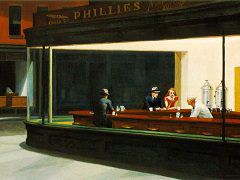
Three guests in a diner and a server. Night life in the 1940s. Dull yellow walls, glass open windows facing the streets.
Bright light illuminating the late dark night through the windows facing the lonely streets. The dull yellow of the wall is reflected all throught drilled dark streets. In 1942 New York practised black out drills - cities dimmed every light to avoid becoming targets from the air. This diner blazing into the dark street was the only light left.
Wooden stools and counter, almost empty. The waiter is having a conversation with a man whose fingers are fiddling a cigarette. And beside him is a sophisticated lady in a red dress. They look like Donna and Harvey to me. Red hair and dress she, and big tie and nose him. They are not holding hands but are almost touching. But, infact they were. Edward Hopper painted himself and his wife josephine as the couple. He painted himself yearning to touch his wife. The pause, the tension, and the heat relates to the post war environment.
There is another man whose back is turned to us. He is in his own world. Maybe after a long day of work. The post war dread and simplicity.
This piece of art is the interpretation of lifestyle. Lifestyle in a certain period in a certain place. This is an archive itself. It conveys the emotions in the time. Predominantly red and green. Opposites. To stop and to go. What would life be post war? They are affluent. They are leading a normal life again. They are quite enjoying the normality of a diner. But the imapact remains.
We see a door to the kitchen that is closed. And we see no way out of the diner. Does that signify that their present is a capsule of man made light they have made for themselves. Are they living in denial? Or is it just people enjoying a nice time, that we consider lavish because of our disdained, perjured presumptions.