The Raft of the Medusa
Théodore Géricault
1818 - 1819
French Romanticism
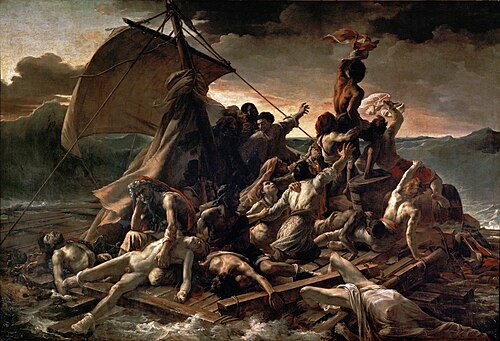
La Radeau de la Méduse. A devasting piece. A golden spiral of people in a broken raft. Some dead, some injured, some given up, and some thriving. People with hope thriving on the dead bodies of fellow sailors. We see a father with his dead son on his lap, not bawling, nor wailing. He is sitting with his dead son. He is aware that he cannot take his son home for his wife to mourn. He knows it is only until his rescue or death he could spend time with his son. He portrays radical acceptance.
This painting shows what a human being is capable of during the hunger to survive. The hope emitted by the people on top waving a cloth to grab a passing ship's attention is giving us chills. There is a moment of exasperation that this dread is over. But the people to the left, who seem like a little gang themselves, who seem like they will come through for one another, aren't happy to the see the ship. The ship passed by. The delirium of presumed joy slipping into despondency. The hope in the eyes of the people under them is scary. We see that they are ready to kill their fellow to survive. We see a man eating another man alive on the right. And the man who is being bitten is not restraining it. He is focused on the rescue ship.
We see a man under them who is grabbing his hair in frustration. He wants to snap out of this situation. He is not ready to enter another battle with these people to be rescued. While people there have died in front of him, due to starvation, dehydration, desparation, they have assaulted the ones beside them, some have jumped into the waves, some just died. He knows that when the ship arrives the fight is going to be vigor and he has to be a part of it.
The bodies in the foreground are all murky and green. They all have been dead for a while. And on top of them there are people pulling the one whose is going on top, and then comes the people who lifts a man to gather the ship's attention. While all these human states are depicted, there is a big wave behind them, that is the nature taking the call.
Theodore contacted with the survivors, took remains of the bodies of the dead, and worked tirelessly on this project. This incident was a big political blue eye. And a depiction of this gains him the recognition he has been hungry for.
I see Theodore also as a victim here. At 27, he has had a radical acceptance of the happening of the incident, and there is a wild human instict of what profits him through this like that cannibals in the second level, and finally he beat himself up in isolation with the darkness of the human race, with the dead's remains, and finally he earned the reputation he was working on.
I also see this as a depiction of life itself. That at the end of the day, when the problem knocks at our doors, we say, "All is fair". Sometimes the hunger in us eats up our conscience. And ones conscience is gone, it is going to be long journey in a wrecked raft called life to gain it back.