Where Do We Come From? What Are We? Where Are We Going?
Paul Gauguin
1897
Post Impressionism
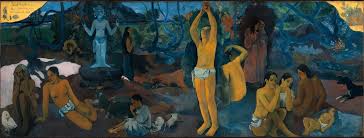
Growing up Paul Gauguin learnt Catholic liturgy - communal worship. And his master encouraged them to question norms and principles. The question, "where" stuck with him. This is his mythology of an ideal, simple, elemental society.
The first impression this painting leaves, on an immediate glance, is a 'Happy Society'. Towards the right end there are three women adoring a sleeping baby. And towards the left end there is an older woman by the lake watching a white bird holding a reptile by its claw. And life is what is in between them. And what connects these corners of life is the half seen black dog in the further right end. Two women walk towards the dog, while mourning.
And what is in the middle is the ripe age of life. A woman plucking a fruit. Another small girl with clothes on tasting the fruit. A woman is leaning towards the old woman who is wretched, attempting to empathise. I would call this The Garden of Life. Dogs, cats, infant, pigeon, statue, trees, bushes, lake and blue sky. Life is a spectrum of practical and emotional experiences and learnings from them. This is a 150 inch depiction of that spectrum.
Paul Gauguin also suffered from severe medical conditions while he was creating this painting. And maybe the fear of facing life forward, while not having the lethargy of 'my body works for an eternity' is reflected in this painting. I compare the central object of this painting, fruit as a symbol of life. Because as long as the fruit is one day, it is going to decompose.
And Paul also heard about his daughter's death during this time. This painting is also her life. She was born, and had a fruitful life, but was gone before he was gone. The miserable woman by the lake is Paul himself. And the white bird is holding a reptile by its claw representing the futility of words because, he has stated in a letter to his friend that he was planning to commit suicide right after this work. This painting is all his understandings, questions, and unknowns of life. "I believe that this canvas not only surpasses all my preceding ones, but that I shall never do anything better- or even like it.", he quoted in his suicide note.
Like he said, he attempted to commit suicide, but was saved. He lived for another 6 years. But what he called the final artistic testament gained him recognition, saved him from debt, and showed him light in his life. If he had died that day, he would've never witnessed the bright side life was holding up for him. He knew this painting was going to change his life. But he was unsure. He didn't want to witness it if it went south. He is an example as to why we should live through. Be it for the good or worse. Because life will answer all our questions right in time, Where Do We Come From? What Are We? Where Are We Going? How big of a regret one will carry if they died without learning their answers? Paul would know.