Confluences, Louvre-AbuDhabi - 2026
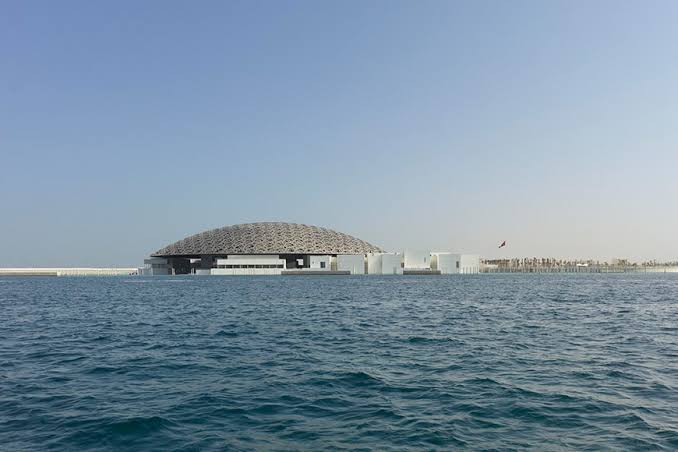
Just like how the raised foot of Lord Nataraja — the Kunchitapadam — dances at what Chidambaram holds as the spiritual center of the earth, long before anyone drew a map with Abu Dhabi sitting at its center: an island held on every side by water, treated now as a kind of neutral equalizer between east and west.
I came across the theme of the Richard Mille Art Prize 2026 — Confluences, framed around migration, trade, and cultural exchange across the Indian Ocean, curated by Kamini Sawhney, founding director of MAP Bengaluru. It intrigued me enough that I sat with the concept for a while, turning it over the way you turn over a word you already thought you understood.
Confluence has always been a path. It carried trade, and it carried the mere exchange of ideas, goods, medicine — the ordinary, generous traffic of people who had something the next shore needed. But the same current that carried a cure also carried a coloniser. The same route that moved a spice moved a smuggler. Like any discovery, confluence holds its good and its bad in the same hand — and history doesn't always let us prove which is which. Some of what the ocean carried is documented, provable, catalogued. Some of it is only remembered, arbitrarily, unevenly, depending on who was left to tell it.
Culture is not static, and it was never independent of itself. There is a constant resemblance, an overlap, that unites every diversity the Indian Ocean ever touched — Tamil temple bronzes echoing in Southeast Asian courts, Arab navigational knowledge shaping South Asian shipbuilding, spice routes becoming pilgrimage routes becoming, eventually, colonial ones. That resemblance exists precisely because of confluence. It is not a coincidence sitting on top of separate cultures. It is the proof that the cultures were never as separate as a map likes to pretend.
This is what I would ask Confluences, the exhibition, to hold onto: don't let the word soften into a metaphor for harmony alone. The museum's own language for the theme speaks of migration, separation, longing, and loss, alongside acceptance, resilience, and regeneration — and that pairing is honest, as far as it goes. But an exhibition can still lean toward the generous half without meaning to, because the generous half is easier to display. A trade route is elegant on a gallery wall. A bronze with clean provenance tells a satisfying story. Displacement, theft, and the quieter kinds of loss rarely leave behind an object so exhibitable. My research into this theme led me directly to Louvre Abu Dhabi's permanent collection, to a bronze standing in this very museum, and to exactly how thin that line can be: one Chola Nataraja moved out of an institution cleanly, and another, cast by the same hands in the same tradition, was proven stolen and sent home only after the theft had already been profited from.
That is confluence too. Not the failure of the idea, but its full shape. The tide never distinguished between what it gave and what it took — it only moved. Whether an exhibition can hold both halves of that honestly, the gift and the extraction, in the same room, without letting one perform for the other, is the real test of a theme this ambitious. I don't yet know which artists this year's edition will include. I know only that the theme, taken seriously, deserves to carry its harder history as visibly as its generous one — because that is the only version of confluence that was ever actually true.