Giorgio Vasari
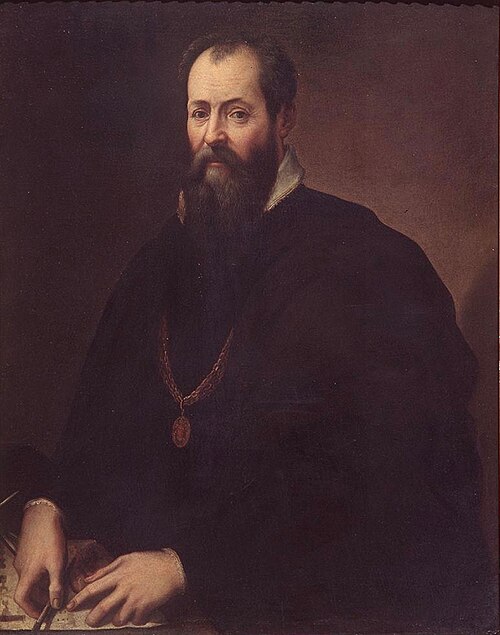
Giorgio Vasari (1511-74) was born in Arezzo in a humble family with believed ancestry in pottery. He was sent to Florence by his grand father with Medici Pope, Clement VIII for an apprenticeship as an artisan. He was in apprenticeship with Michelangelo and later when Michelangelo moved to Rome, he continued with Andrea del Sarto and Baccio Bandinelli. He also studied with two Medici offspring- Ippolito and Alessandro. He was best friends with Rosso Fiorentino and Francesco Salviati.
Alessandro was assassinated in 1527 and the First Edition of Lives was published in 1550.
His first lessons were from the cousin of his grand father Luca Signorelli.
In 1541 he travelled to Venice. While his return, on a dinner table with Medici family, new artists were spoken about and a suggestion to Vasari was made to write biographies of The Great Italian Artists.
In 1546 he recieved his first major commission to decorate the main hall in Palazzo della Cancelleria, owned by the Farnese family. It was later called the Sala dei Cento Giorni (The Hall of the One Hundred Days) as Vasari completed the Fresco in 100 days with an army of assistant artists.
First edition was named after the typographer Lorenzo Torrentino, as the Torrentino edition. He got a gift for that work from Michelangelo Buonarroti, the century's famous artist and lyric poet.
He got more commissions from Pope and Duke Cosimo de' Medici of Florence, who became a friend and patron of Giorgio Vasari. One of these commissions were remodelling the Vecchio with a series of allegorical and historical scenes. He constructed the today's Uffizi, the then Government offices. Remodelled Pisa's Piazza dei Cavalieri.
He established the Florentine Academy of Design in 1562. He also decorated the tomb in Santa Croce Church for Michelangelo's final rights.
The second editions of Lives was published in 1568 and was named after the Florentine typographer, Jacopo Giunti, as the Giunti edition.
He passed away with respect and admiration of his patrons and peers as a skillful architect, an accomplished painter in 1574.
He virtually invented the discipline of Art History
He never addressed artists as artista but as artigiano, more accurate to in Italian.
Renaissance Archival
He believed and followed that art and beauty went hand-in-hand and whatever was beautiful for his eyes were art to him.