Automat
Edward Hopper
1927
Realism
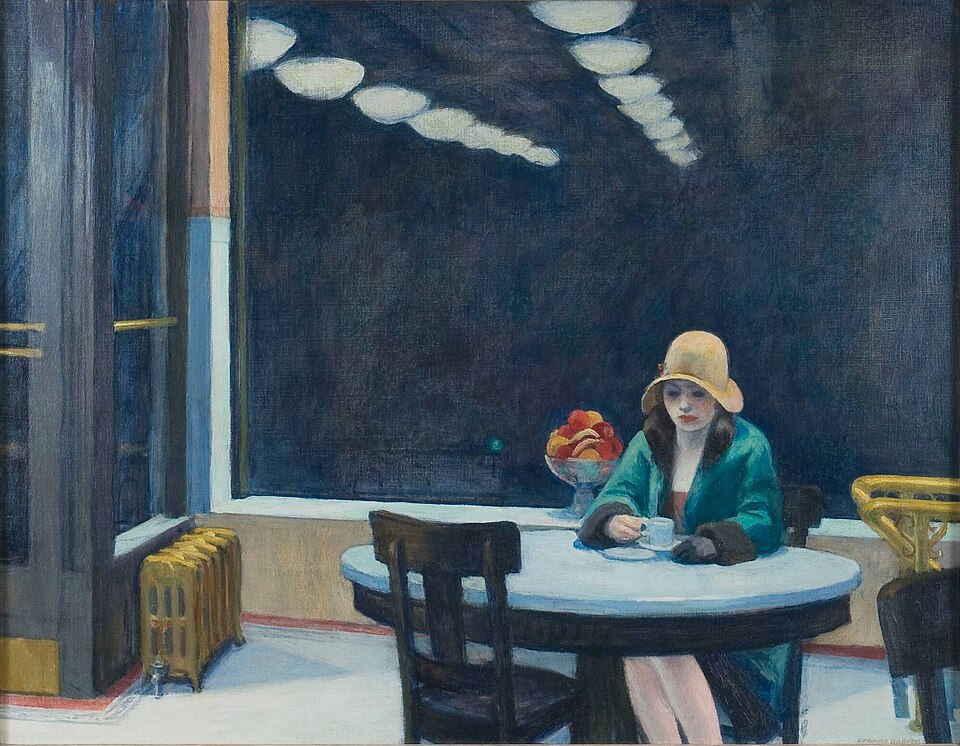
Independence and loneliness. A poised lady, knees together, a glove on, holding a cup. The image of New York city that has never been illustrated. A dark street, no cars or pedestrians or gleaming lights. The lights of the Automat is reflected in the glass beside her suggesting her inner reality. She now has to face the loneliness. She is reminiscing a moment lived, but doubting if she has to regret letting go of it. The empty chair opposite to her plays the character of her older self, that she is talking to. "Are you still proud of me?"
The "New Woman" of the Twenties, first to enter the workforce, first time socially accepted for being seated alone in a fast food in and out without her male chaperone, wearing a fur coat and a cloche hat, and red lips. The one glove off narrates her absent mind. She is surrounded by lights and emptiness that is beaming at her hidden inner self.
A cold, dark, deserted night breaking the illusion of connection. A place where people flock to eat cheaply with vending machines making it impossible to have human contact. The irony and imbalance created everytime a revolution is attempted. It takes time for people to get accustomed to change. Until the ripples settles there persists regrets, or rather confusions. You blink an eye, make a choice for the greater good, you are still where you were with the consequences not the outcomes.
The apples and peaches at the back in a glass fruit vase suggest the nectar and poison that come together with decisions, actions, and change. But, what if she just had a long day, having a snack and a beverage before heading home to continue to work around the chores? A woman with an empty snack plate, with her alter ego to cook a vessel full of food, do the dishes, laundry, clean the window, and so on. Her image is more like what they call, "Man's work is from sun to sun, and a woman's work is never done."
Automat - an invention to avoid wait staff and unnecessary time consumption during working hours, for a fast paced life, always buzzing with nickel clinking in the machines, leaves a woman isolated, with no one to ask "Are you alright?" The space is needed, is given but is bitter.
Her circumstances, mood and story are all ambiguous. But I see myself in her. With a hundred people to dial, sometimes in a city that was home, or sometimes not, one is left to nudge, push and sometimes sit around to find their place. This painting is what existence, presence, and survival would look like.