The Lady of Shalott
John William Waterhouse
1888
Pre-Raphaelite
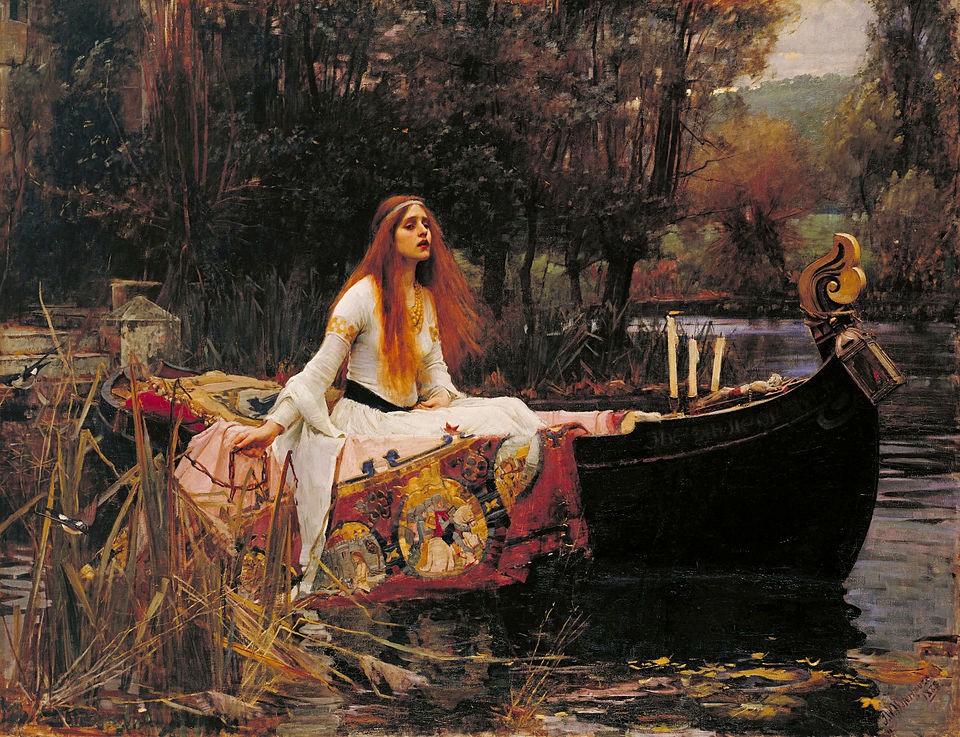
A moment of life and death. Desire and apathy. Bliss and regret. Inspired from a poem written by Lord Tennyson in 1832, this painting is the image of
"She left the web, she left the loom
She made three paces thro' the room
She saw the water-flower bloom,
She saw the helmet and the plume,
She look'd down to Camelot.
Out flew the web and floated wide;
The mirror crack'd from side to side;
'The curse is come upon me,' cried
The Lady of Shalott."
A moment of desire to see the world not through a magical tapestry, which is also the cob web that has arrested her. Surrounded by gray walls on a castle, suppressing her yearning to see the lake, the yellow autumn leaves, and the beauty of the misty world. She was cursed. She could not experience the bloom of the spring, the moon bath, or the first snow. If she did break off from the curse, she will be punished with death.
The fear locked her in while her misery was ever growing. "I am half sick of shadows", she says. She has been seeing events of the outside world as a reflection. First time something asserted her that the life outside is real, is the movement of Sir Lancelot. She needed the affirmation to liberate herself.
Autumn happens to be the season of decay- representing her death. There are three candles in the boat, a bow and a crucifix. Two candles already blown out by the wind, while she was detangling the boat chain. It was her moment of realisation that it was over. The glow she is still lingering on her face, but her expression shifted. Her left hand folded along her wrist resting on her thigh like she has given up. Her lips parted singing her last words. There is no memory of Sir Lancelot at this moment, she is cherishing her little time with the lake, the lilies, and the fields.
This perfect expression was modelled by Muriel Foster. This painting does not represent the narrative peak of the story, she looking outside the window, or the breaking of the glass. While that would've paved way for suppressed women of the Victorian era to also break free. Besides, he painted the consequence scaring the women with the outcomes. This is a political move, and also a reason why this painting recieved immediate triumph when exhibited.
But while he was true to the character Shalott, he captured her yearning, the betrayal, the questions she carried in herself very well. The raised eyebrows towards the bridge of her nose, the head tilted up in exasperation, the wind caressing her hair to put off the last candle stub. This was the moment that put women behind the tapestry, killed their freedom on a murky lakeside for an entire era. This painting is a beauty under a curse. The Lady of Shalott.