Dance
Henri Matisse
1909 - 1910
Fauvism / Early Modernism
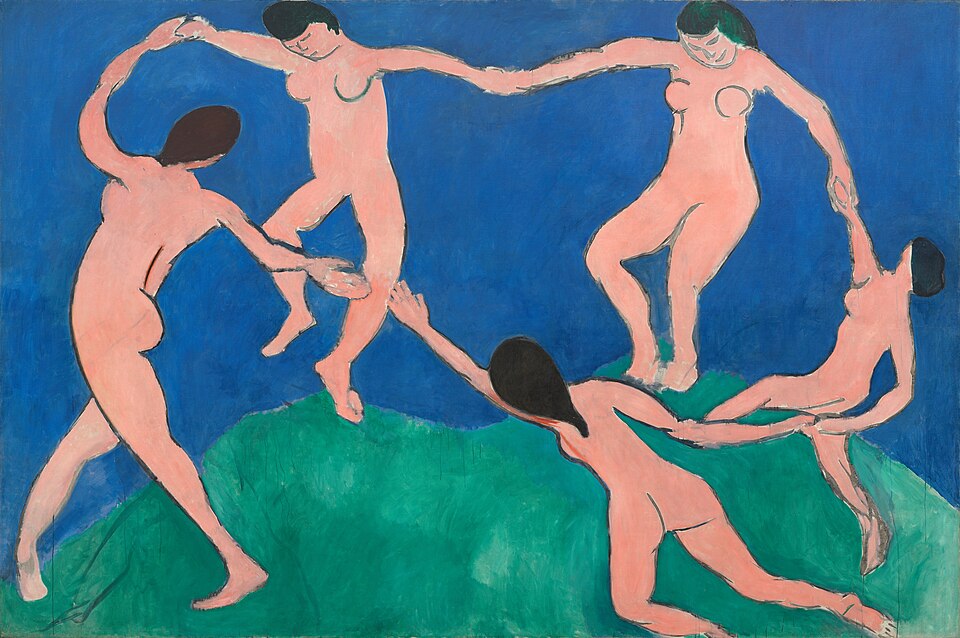
The usage of unnatural colours to embody the emotions, and the rhythm brought out of life, not realistically but to express above and beyond. The exuberance felt by an underground radical artist, and the freedom he has to celebrate the rise of primitivism is Dance. A pagan circle dance, with men and women stripped away of the then modern clothing and genesis of technology, forgetting the material world and reconnecting with the serenity by the bare body of human nature.
While Dance (I) has more muted tones of blue, green and pale skin with not sharp definition of the bodies of the dancers, it speaks of a free mind painting toward something — awareness packed and sealed with hope. Dance (I) was his origin success story. When Sergei Shchukin commissioned Matisse to paint Dance for him, Dance (II) carried all the higher contrast that defined Fauvism better. Higher contrast created by the fiery reddish orange bodies, and deep blue skies, and lush green earth. The bodies have become sharper, with details and carried the kinetics that Matisse got after knowing he is not going to struggle for a meal or to support his family anymore.
The Studio Diplomatic Rivalry between Matisse and Picasso, between colours and monochrome, and between soft rhythmic structures and disrupted human as cubic forms were all at its peak. This comparison did not kill the vibrance of the art world then but fuelled two prominent art movements in the making. Fauvism and Cubism.
Dance(I) was the joy of an artist, Dance (II) was the joy of a man. Dance (I) was inspired by the contemporary performances of Isadora Duncan, who broke the barriers and rule sets of traditional dance forms, making it simple for any group of people to dance. Dance(I) was the excitement of an artist gripping to hope that he could alter grammar in his field. Dance (II) was the happiness that Isadora Duncan would have danced with. The happiness of travelling a small but full circle, and knowing that there is more after attaining an ambition. Dance (I) is how Matisse went to bed with the happiness of having created something, Dance (II) is how Matisse went to bed as a father who provides without giving up on himself.