Mogamma
Julie Mehretu
2012
Gestural Abstraction
The Guggenheim Abu Dhabi]], Abu Dhabi
The High Museum of Art, Atlanta
The Tate Modern, London
The Museum of Fine Arts Houston
Ink and acrylic on canvas
This painting is not a reminder of horror. It is an archive — the kind that doesn't ask to be remembered, it insists on being answered to.
Mogamma means assembly. The building in Cairo's Tahrir Square was exactly that — an assembly of bureaucratic power, a brutalist monolith that compressed an entire nation's civic life into its corridors and stamped it with delay, denial, and exhaustion. Julie Mehretu does not paint the building. She paints what the building did.
Had we protested an oppressive government — not for the enthusiasm of a crowd, but in the genuine fear of losing the future of the motherland, questioning our children's futures in this land, or worse, becoming refugees in another country because we could not find the light of day for an entire nation — we would not feel shameful. We would feel disabled. Broken. And when millions of such people win, when they bring a country back onto its own two feet, they sleep. But what haunts them from the past would look exactly like Mogamma. The place where they gathered is not the same public square anymore. It has been returned to them, and it has not.
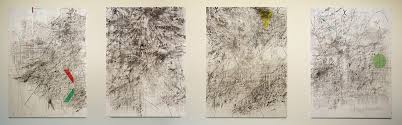
The faded architectural drawing buried beneath the painting's surface is not background. It is evidence. The building remains — its geometry, its facades, its institutional skeleton — but it is submerged under everything it caused. Loose, stretched lines. Fragments of flag colour appearing and dissolving. The scattering, whether intended or not, adds its own brutal poetry. Standing before all four canvases, it's hard not to feel them as four facades of the same pressure — as if the building's walls had each taken a separate blow and kept no record of which direction it came from.
What Mehretu uses to build this surface matters as much as what she builds. Ink pen, brushwork, charcoal, stencils, and digital layering converge on a single plane — the way people with irreconcilable political opinions converge on a single square when the alternative is unthinkable. But it is the digital noise laid directly over the architectural blueprint that carries the sharpest argument. The youth do not annotate the institution's drawing. They overwhelm it. Their presence does not revise the structure of power — it buries it in signal, in motion, in the irreducible evidence of having been there.
Anybody can look at a photograph of Tahrir Square and say, poor them. Mehretu refuses that transaction entirely. Mogamma does not ask for sympathy. It demands institutional accountability — quietly, formally, across four canvases and several thousand square feet of accumulated mark-making. It tells any institution, in any country, in any century: we were here, we recorded what you did, and we made it beautiful so you could never look away.