Las Meninas
Diego Velázquez
1656
Baroque, Spanish Golden Age
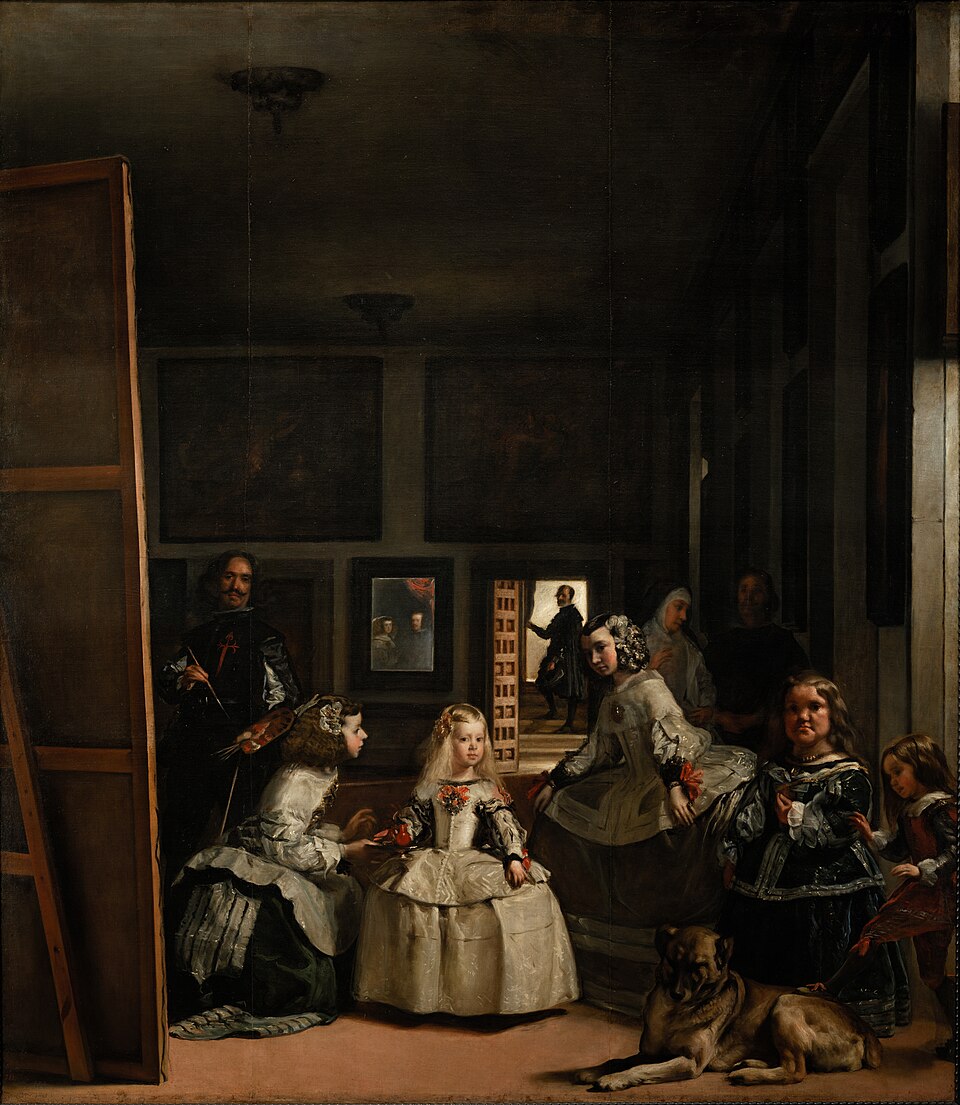
Las Meninas is the first ever immersive experience in the art world. Way before 3D, Las Meninas creates an illusion for the viewer as a part of the room. Diego having served the Royal family for 33 years, had great insights about the family and their portrayal. And as a connoisseur art, Philip IV encouraged and admired Diego and his works. This gave him the creative freedom to explore portraits in dimensions with the Royal family. Being a patron of this craft, Philip IV equipped Diego with the biggest studio in the palace.
The central figure of Las Meninas is Margaret Theresa. The daughter of King Philip IV and his second wife Mariana of Austria. She is surrounded by her entourage of chaperones. A girl kneeling to the left communicating with her, and the girl to the right being attentive, Diego is painting in a life size canvas the King and his Queen. Their reflection is captured in the mirror. So they are amidst us in the viewer stand, and two dwarf sized people, one looking towards the subjects of Diego's portrait that he is painting in the this portrait, the z axis, that is the viewer's side.
There is man walking up the stairs caught behind Margaret through an open door gap. There is a nun and a church service man standing behind the girls, discussing among themselves. Diego has caught a random day in the Palace with clear perfection and involvement that the audience feel like they are experiencing the same with the characters. There is a dog sulking, a boy kicking and playing with it. We are so close to wanting to step in and comfort the dog.
The reason for feeling so is Princess Margaret, the attentive girl to the right, the man throught the door, the dwarf girl, the sulking dog, the church man, Diego, and especially the King and the Queen through the mirror looks at or focuses on one point. That is where we stand and watch the painting. It is intimidating to have so many characters in a painting, from various dimensions looking at us straight in the eye from an entirely different timeline.
This is an alive art. Picasso painted 58 versions of this painting obsessively trying to understand the execution of the geometry and parallel universe in it. How would have Diego achieved it? This is the of the freedom given to him to explore. But was he exploring it all. He was the leading artist in Philip's court for decades. His subjects were repetitive. Is the loop or restriction to explore beyond the palace the reason for this beyond remarkable thought process? Did Diego ever want to paint a bad landscape, sleep there, and call it a day? The grass is always greener on the other side, isn't?