Miss Everything (Unsuppressed Deliverance)
Amy Sherald
2013
Contemporary Art
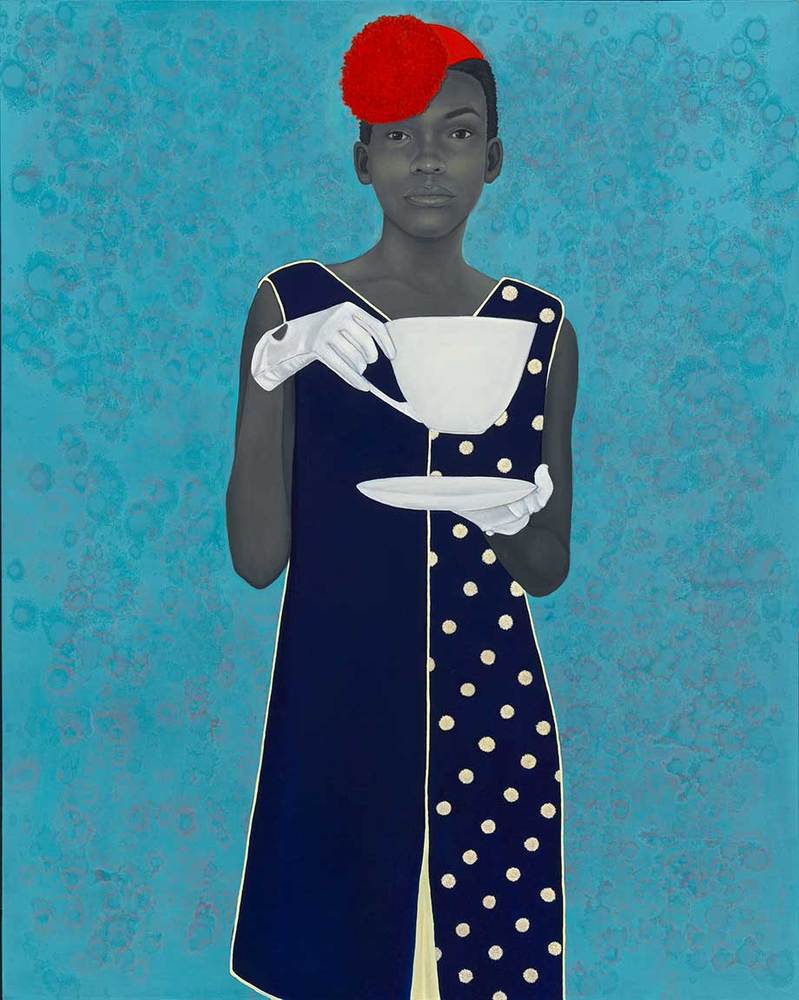
A young girl stands holding a teacup and saucer balanced at the very tips of her silk-gloved fingers. She wears a black polka dot dress. A red hat with a fringed flower sits on her head. Her posture is unhurried, perfectly composed. She is not performing composure — she simply has it.
And her skin is gray.
Amy Sherald paints her Black subjects in grisaille — a technique that renders skin in achromatic tones, lifting it out of the register of literal race. The choice is not erasure. It is precision. A painting of a dark-skinned girl in a tea dress and gloves would ask some viewers to confront their assumptions about Black girlhood and elite culture — but it would let others opt out. It would become, for those viewers, a conversation they could choose not to have. The gray forecloses that exit. It abstracts race just enough to make race the only thing you can think about. The challenge becomes universal, not selective. Every viewer is implicated.
Now consider what she is holding. The teacup, the white glove, the hat with its decorative flower — these are not neutral objects. They are inherited symbols of a specific class performance. High-tea elegance is not stumbled into. It is drilled in from early childhood: how to hold a cup, how to smile without opening your mouth too wide, how to occupy a room without disturbing its air. It is a form of inheritance as much as a wardrobe. It belongs, in the cultural imagination, to a particular lineage.
The girl in this painting has it. All of it. And she was not supposed to.
This is where Sherald's argument sharpens into something more than representation. There is a common resistance — still alive, still reflexive — to seeing a Black girl in this register. Not because grace is absent from Black communities, but because the dominant cultural script does not write her into it. Black children are often self-made in ways that elite culture does not recognize as making. They are taught to believe, to endure, to be true and kind and hardworking. They are not escorted to high-teas and trained in the performance of stillness. So the resistance, when it rises in a viewer confronting this painting, is not simply racial prejudice. It is the friction of a familiar story being interrupted.
But Sherald is not making an argument for inclusion. She is not asking the world of white gloves and tea ceremonies to open its doors a little wider. The girl is not at the threshold, waiting. She is already inside — and she is not changed by it. She holds the cup with the same ease with which she would hold anything else. The elegance is not borrowed. It is not performed for approval. It simply is, the way breathing is. That is what unsettles.
When we close our eyes and call up the image of a Black girl or a Black woman, we often reach for warmth and motion — the wide, welcoming smile, hair unbound or braided with intention, bright colors, a body that moves freely through space rather than holding itself rigid within it. Blackness, in the cultural imagination, symbolizes life in its most uncontained form. And it does. But Sherald's point is not to contest that image. Her point is to demonstrate that containment, stillness, and the deliberate balancing of a teacup are not the opposite of that life. They are another form of it.
The real provocation of this painting is not that a Black girl can be elegant. It is that the world built an entire architecture of rules, objects, and rituals to define elegance — and then called it universal. Sherald places her subject inside that architecture, perfectly at ease, and lets the architecture look small. The girl is not asking to be recognized as elegant. She already knows what she is. The question the painting puts back to the viewer is whether the viewer's definition of elegance was ever large enough to begin with.
She is holding the teacup. She always was.