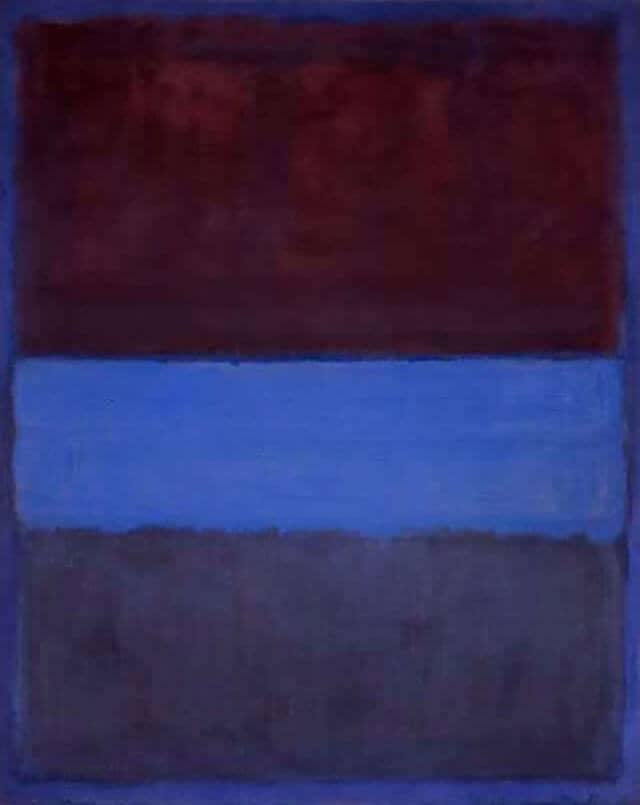
No. 61 (Rust and Blue)
Mark Rothko
1953
Abstract Expressionism
To the portraits and other works with subjects in them, a friend of mine asked me this.
"I wonder what you will write about these pieces of art if you had no information, nothing at all except the art itself. I do understand the importance of the artist in establishing a connection with the art, the history, and the timeline but I also know that there is so much at stake regarding history that is bound to have been deviated far beyond one's imagination."
It got me thinking. Our observation is confining and finite with respect to paintings with a subject and a story that we can narrate around that. Sometimes we know the facts before we see the painting. The reflection of self is limited in such cases. The narrative and our understanding and perspective is regulated, and sometimes uniform. Rust and Blue is a way to awaken the inner us. The artist famously describes this piece as inner light.
Rust and Blue will be a view on a summer night, in an empty beach. Moon behind dark, sad clouds, luminous water. Rust and Blue will be the half shut window, cancelling the noise of a busy day. It is the symbolism of meditative time that one spends with themselves. The passion, love, greed to live a full life, ambition, and confidence all snap away from the rust to harmony, happiness, excitement in blue- to peace, serenity, and bliss in indigo.
Rothko built a world for viewers to dissolve and teleport into. He was the viewer's artist. He titled his works as numbers and mere colours to confine the viewer's experience as vast as they could imagine and not to open interpretation doors for them.