The Great Wave off Kanagawa
Katsushika Hokusai
1831
Ukiyo-e
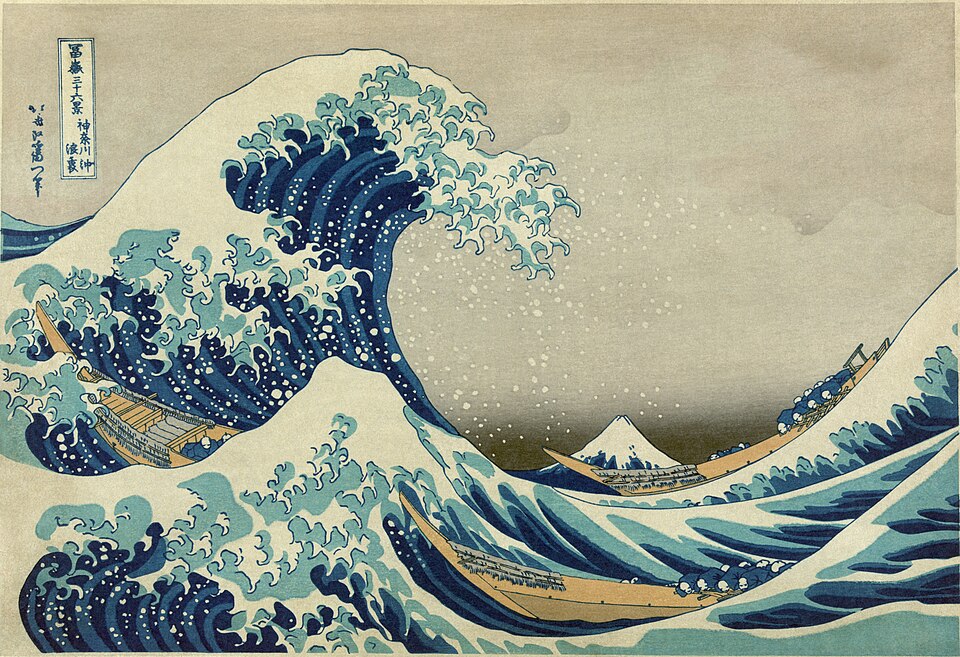
A geometrical masterpiece. Hokusai believed that any image can be brought into composition by merely using circles, triangles and squares. So was his works.Thirty-Six views of Mount Fuji, sometimes hidden, sometimes seeking the attention. The Great Wave off Kanagawa is the first of that series. And here the Mount Fuji is camouflaged by the resisted wave which is a giant triangle by itself. The print is a parameter driven geometrical diagram with a precise composition that can be reconstructed from measurements alone. The whole composition is geometry pretending to be nature.
There are 35 other angles in this series, which was later expanded to 46 from which the Mount Fuji was outlined and monochrome painted by Katsushika Hokusai. He had nothing to do with the Prussian Blue that overtook the art industry by that time. Ukiyo-e method involves 4 crafts man to get it to life. An artist, a wood carver, a painter and a decision maker. Here Nishimuraya Yohachi was the publisher and decision maker who was the mastermind behind the usage of Prussian Blue. And two other anonymous craftsmen carved the wood and printed using it. Ukiyo-e is a tradition, using pictures of the floating world, images of daily life, of landscape and beautiful women carved into wood and printed for mass distribution, not an exclusive collection. So, the decision of Prussian Blue or the wave were all vivid, practical decisions.
Achieving a 3 Dimensional effect on a paper with nuances of the wave, the resistance caused between the to and fro wave, the boats, the water splashing and a simple mountain behind it, carving the little details on wood in accordance with the outline provided by the artist is worth a team. Speaking of the impressive work by the wood carver, we should not forget the printer. Although the the decision of altering Art History, using Prussian Blue was not made by him, the nuance of creating shadow on water, and achieving the blend between the green forest and sky from afar using print technique is commendable too.
A great wave, and a giant mountain, and the philosophy of perception. The wave seems bigger than a titanic mountain. And the men clinging to the boats, like how one embraces the tides of life, be it a strong one that could flip and sink you over or the one that you dance along with. It is the same wave but how one perceives it. We play with waves, contemplate with waves, stand with them, and they embrace us, take us over, or leave us behind- all the dynamics that humankind will experience in a lifetime. The Great Wave off Kanagawa, is an artistic and philosophical masterpiece.