The Parquet Planers
Gustave Caillebotte
1875
Impressionism
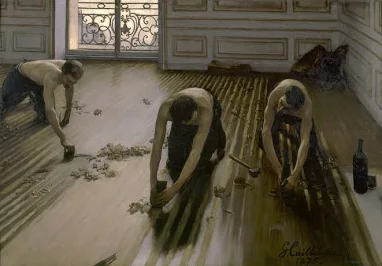
Les raboteurs de parquet. The behind the scenes of any monument, home, or shelter being built. Whilst the world is a mere web of co-depended people, three men are relied on for the wood to be scrapped. The conversation between the two men to the right would have been the last man to man, eye to eye conversation in that room, the bottle of wine would be the last to have been shared by three people in a single glass. It is the kind of luxury that the owners can't afford.
What an irony it is? Would any of these three man even dream about spending money on changing a floor. If they had dreamt of a home, it would not be about the furniture matching the floor and the curtains. It would be about the comfort of the people in it, people they love. But this absurdness pays them off to treat the people they love. The irony of financial hierarchy. And what feeds its existence.
While it was common to paint peasants, urban working class were never considered as subjects. But The Parquet Planers is not just a revolution, but also a statement. The reconstruction of medieval Paris into a luxury metropolis. The redefining moment of new elite. But this wasn't a symbol of mighty wealth, but of labor. The labor of the community that didn't exploit the opportunity of war scene to fund opulent lifestyle and gamble in real estate. This is an inevitable scene of sweaty workforce invading the burgeois spaces.
Gustave Caillebotte was a rich man himself. But he was a quiet and fiercely loyal painter. His brother was photographer. The awareness of the functions of lens capturing light made it possible for him to create the bright light effect through the window, without explicitly painting the beam. The technique he uses to achieve the bright light flooding through the window all through the floor was called contre-jour(painting against the light source).
He wasn't just a curious, rich painter. He was a patron. He primarily spent his inheritance wealth in saving his artist friends who couldn't financially keep it afloat. He had paid studio rent for major Impression artists like Claude Monet and Pierre-Auguste Renoir. He bought impression paintings at high prices to keep up their dignity and help them as well.
He is called the Saviour of Impressionism, because before he died he commissioned his vast collection to the then-reluctant French government on the condition of leaving them to public display.
A man who created a legacy for other artists. A man who painted almost like a print the irony of rich bureaucratic and hardworking labors. A man who only focused on techniques and realistic result. So much so that he painted this again, with just two workers and one with his shirt on. He was painting not to be seen. He was painting to explore how skillfully abled he was. He adjusted the composition and light to make the painting tamer and less radical. He wanted to achieve the reality.
This painting is how coexisting prevails. Anyone makes a life out of others labor. The workers are using the extravagant house to make a job and an income out of it, the landlord renovates, rents and makes and income out of it, artists like Pierre-Auguste Renoir rents out this place to paint and earn a living through it. And the last tier is Gustave Caillebotte, who understands the practicality of the web, not the tier, is at peace with making an art to test his excellence through it.