The Ladies of Avignon
Pablo Picasso
1907
Proto-Cubism
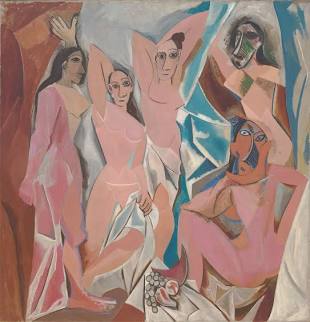
Les Demoiselles d'Avignon. Originally titled Le Bordel d'Avignon (The Avignon Brothel), or simply Mon Bordel (My Brothel). Picasso wanted the title to be gritty. But when art critic André Salmon prepared it for public exhibition in 1916, he changed it — not out of personal offense, but out of fear. Wartime censors and a deeply conservative public made a painting titled The Brothel a liability that could shut the entire exhibition down. Picasso was irritated by the change for the rest of his life.
Five nude, confrontational, and bold ladies of a brothel street in Barcelona, Spain. This painting is nothing of sorts with how Renaissance or Baroque would have depicted prostitutes. Not glamorous or sensual. They are bold and political. The subjects are aware of the avant-garde they are going to set.
This painting is an inspiration from various artists that Picasso looked up to. The inclusive nature of the subject from Las Meninas by Diego Velázquez, the unreal structure and the blues and reds from Henri Matisse. While he did draw inspiration from their works, he had his vision for his work. Unlike the flow of the structure of Henri Matisse's subjects, Picasso gave them an oblique structure, making this a primitive step for the birth of cubism, and unlike reflecting on himself and his lifelong work in Las Meninas, Picasso did not use himself in the portrait.
Five women. The figure to the left is identified as Iberian, her garment sliding off her shoulder like a cape. The two women at the centre carry the angular stillness of Iberian sculpture — flat, frontal, monumental. The two women to the right wear what are now identified as African Fang masks and Kongo-influenced forms, objects Picasso had studied at the Trocadéro ethnographic museum in Paris in 1907. That visit changed everything. He described it later as a revelation — not aesthetic but spiritual. He understood for the first time that African objects were not decorative artifacts but repositories of power, made to confront forces that could not be named.
Sharp edges of the shoulder, femininity in the masculine poses, grapes that are inviting but eyes that are warning, the red and blue. This work is a representation of conflict. The whole image is like a reflection on a shattered glass. The broken glass is the attempt that France made while expanding their reign all through Sub-Saharan Africa, by stealing their artifacts and incorporating them as their own "civilizing" colonial dominance. He saw that African art carried a raw spiritual power. This painting was to enrage a segment of the French public that was entitled and complacent. It is also his hidden competition or rivalry with Henri Matisse. As just a year before, Matisse was celebrating the success of Le Bonheur de Vivre — this was Picasso attempting to secure his own spot at the top of the art world, using the Fauvism structure, but sharpening them and making it cubes.
When Picasso finally unveiled Les Demoiselles d'Avignon to his inner circle of artists and critics in late 1907, the reaction was nearly universal horror and disgust. Henri Matisse was furious, viewing the painting as a cynical mockery of modern art. The painter Georges Braque remarked that looking at it felt like "drinking petrol and breathing fire."
It was so universally hated that Picasso rolled the canvas up and hid it away in his studio for years. It wasn't publicly exhibited until 1916, and it wasn't fully appreciated until the 1920s when the world finally caught up to the language of Cubism that Picasso had violently birthed in 1907.
Besides all the radical art world rivalry and hunt for a position, these women were the modern Olympia by Édouard Manet. Both paintings weaponised the direct gaze. Both used female subjects to make an argument about power that had nothing to do with the women themselves. Despite the tag that the area carries, they are confident, and they carry a story — a story that narrates the history of not just themselves but the place. They are aware that they are the faces of a political authoritarianism. And they are not looking away.