The Swing
Jean-Honoré Fragonard
1767-68
Rococo
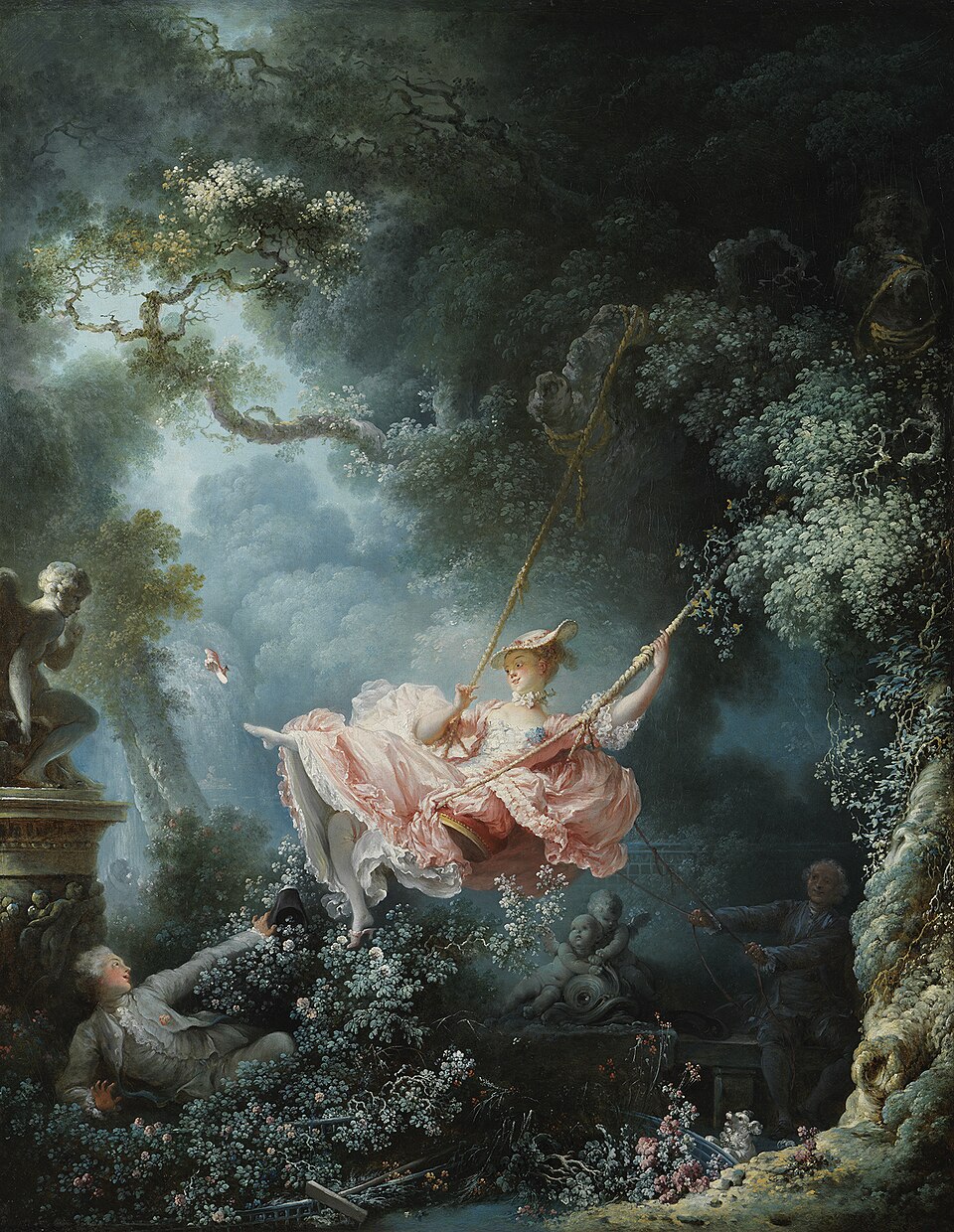
In a lush green garden, there swings a beautiful woman, kicking her shoes in joy, a man filled with happiness looking at her, a puppy jumping in excitement beneath her, and another man propels the swing with a rope. The image looks almost unreal. The bushes, the blossoms, and the density. The green of the scene matches the man's shirt, and the blossoms matches her dress. The daylight peeping through the canopy just on her, surrounded by a beautiful garden, far away from home which is hidden in the shadows, more like a dream. Too happy to be real.
Albeit the scene is filled with happiness, playfulness, and candid romance, somehow it lacks love. Maybe because couples of the 18th century were never portrayed to be frivolous. They maintained decorum, etiquette, and were always on point, especially the aristocrats. When these two are exhilarated, the cupid to the left feels more alive than a statue asking them to quiet down. Perhaps, the love that was shot at the hearts of this couple is not socially accepted. That also gives them the thrill of having fun moments, than a normal couple. It is more validating by the look on the cherubs, Putti, who looks up at the lady with concern on his face. The concern caused by an awareness of secrecy. A concern that failed to haunt the real men in scene as they are deluded by desire and beauty of the scene, the baby angels perceive it well.
It does also seem otherwise, a normal, noble couple-- a lady in a lustrous dress, having her moment and her husband is happy to have kept his wife well, and maybe she kicks to save her heels from falling into the water stream under the swing. But it is also said that the artist was requested by a friend to paint him with his mistress, and Fragonard particularly changed the characters causing a rift between them. Fragonard should've liked the scene and the ambiguity underneath the beauty elements. The whole of Rococo movement was defined by paintings of aristocratic leisure as a philosophical aesthetic. Something as deep and consuming as French Revolution challenged Rococo with reality that it could never face.
The perfect aesthetic maintained as rule and obsession by the artist makes the beauty of this painting irresistibly addictive, because the cloying nature of the scene is balanced by the moral dubiousness that this painting sells. I would call this painting a dream come true. But what if she was his mistress? Would it still be a dream come true? Would the characters want to alter something about the scene? Because as much as this scene is beautiful it is also eerie, like the wife is watching from the hidden balcony, from the shadows.