Never Enough Chapter-01
Van Gogh & Mark Rothko
The archive opens with an artist who has spent a lifetime listening to it and sat with it
Apr, 2026

Before the paintings, before the letters, before the yellow house and the colour field and the chapel in Houston — there were two households in which something necessary was withheld.
Not withheld cruelly. That would be a simpler story. Both families loved their strange, difficult sons. Both were themselves besieged — by grief, by fear, by circumstances they had not chosen. They gave what they had. What they had was not quite enough, and each boy grew up around that insufficiency the way a tree grows around a wall — shaped permanently by the thing he could never move through.
One boy was measured against a ghost. The other against a continent that wanted him erased. The paintings, later, would be the place where the missing thing finally had room.
I.
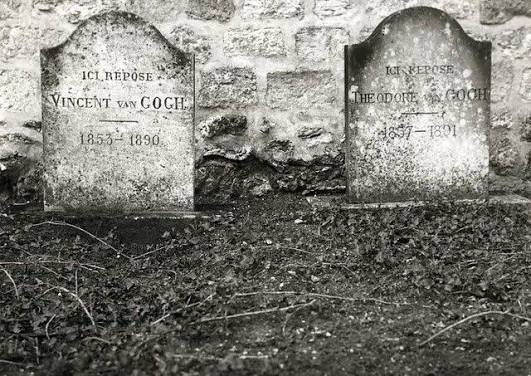
The churchyard at Zundert holds a headstone that reads Vincent Willem van Gogh, and beneath it, no body that ever drew breath. The child was stillborn on the 30th of March 1852. A year later, on the same date, Anna van Gogh-Carbentus gave birth to her second son. She named him Vincent Willem also.
What this meant to the boy who grew up reading his own name in stone — he never said anything directly. But the fact organised itself quietly around everything else that followed. Nobody has a record of why she did it. Maybe because she saw him as a replacement of her first child, that was supposed to give her the credit of status of being a mother. Or she was simply following the tradition of naming her first child after their forefathers.
Anna was thirty-two, a minister's wife, a woman of decent capability and frustration. She had married Theodorus van Gogh — a kind, unremarkable man — when she was already considered late to it. She had expected, perhaps, something more. She did not dwell on disappointment; she was not that kind of woman. Instead she worked. The house kept, the linen pressed, the accounts correct, the surfaces of daily life maintained with an attention that left little room for anything that could not be managed. She moved, always, as if stillness might let something in. She often said, "Force your mind to keep itself occupied by other things."
She believed, with some conviction, that education without refinement was a threat to the family's standing reputation. When she decided that the local village children were too rough for her son, she removed Vincent from school and kept him home. The boy who might have found companionship in a classroom instead found it in fields — in beetles, in birds' nests, in the flat grey light of the Dutch countryside. Nature did not measure him. Nature simply continued.
He was not a neat child. This mattered to Anna greatly. Neatness was legible to her — it meant things were under control, that the self was properly managed. Vincent, who went through life with paint on his hands and mud on his boots and an expression that suggested he was only half-present in whichever room he occupied, was a constant source of anxiety to a woman who had organised her entire inner world around the principle that chaos, kept at bay, could be survived.
She loved him, in her way. Her way was to hold him to a standard he found, consistently, just out of reach. "She makes such a fuss if anything goes a little wrong," he wrote once to Theo, and left it at that. What she gave instead of praise was the relentless measuring of distance between what he was and what she needed him to become.
He had a habit, as a boy, of telling The Story of a Mother by Hans Christian Andersen — a tale in which a mother bargains away everything, including her own eyes, to keep her child alive. He told it repeatedly, to anyone who would listen. That a boy who felt perpetually unseen by his mother returned again and again to a story about the ferocity of maternal love is not a difficult thing to read. The validation he could not claim at the dinner table, he found in a fairy tale.
He walked past the first Vincent's grave on his way to school.
The mathematics of that fact is simple and devastating: he was a replacement who could never replace, a living proof of something that had already failed. Anna's fear of good things not lasting — the deep, privately held conviction that joy was provisional and order was the only honest response to a world that could take everything — meant that she could never quite let herself love him without simultaneously bracing for the loss of him. And that tension, worn daily, made her hands close rather than open.
He was her errand. Her proof that things, this time, could be made perfect.
II.
In Dvinsk, in 1903, the fear arrived before the explanations did.
The world into which Markus Rothkowitz was born had a specific quality of dread. The Russian Empire's Pale of Settlement was a geography of controlled confinement — Jewish families permitted to exist within designated borders, permitted to work within designated trades, permitted- in theory, to survive- in practice. Theory had limits. The pogroms that swept through the region that year were not abstract. They arrived with names attached, with specific addresses, with the sound of glass.
Before he could reliably distinguish one face from another, Markus understood that his parents were afraid to send him to the park. This was not something anyone explained to him. It was simply in the air of every room — the particular atmospheric pressure of a household that has learned, through repeated experience, that the world outside is not indifferent to your existence but actively hostile to it.
His father, Jacob Rothkowitz, was a pharmacist — and, by deep conviction, a secular man. He had reasoned his way out of the religious world his own father had inhabited. He was educated, politically engaged, interested in ideas. He had raised his older children in that clean, rational light, and he had intended, one gathers, to do the same for his youngest.
He sent Markus to the cheder at five years old.
Fear is a powerful editor of principles.
The cheder was the traditional religious schoolroom: small, enclosed, organised entirely around scripture and the memorisation of scripture. It was the world Jacob had left behind. That he returned his youngest son to it says something about the year, and about the terror inside it, that argument could not quite reach. If the Tsar's soldiers were coming for Jewish boys, perhaps a Jewish boy who appeared sufficiently pious might be passed over. It was the logic of the powerless — not irrational, and not, in the end, particularly effective.
Markus, alone among his siblings in this confinement, experienced it not as faith but as sentence. While his brothers and sisters had grown up with Jacob's secularism — with books, with argument, with the sense that ideas were tools rather than walls — Markus was handed a cage built from the very fear that had already shaped every room he had ever been in. He was not being punished. He was being protected. The difference, to a five-year-old sealed inside scripture while the world continued outside, was invisible.
The family was not cold. It was the opposite: a beautiful, dense, humming thing — a hive of political intensity, literary argument, collective survival. But it was in a permanent state of emergency, and love expressed under emergency conditions does not always arrive in a recognisable form. There was no space for a moment that was only a moment. Every tenderness was undercut by the awareness that it might be the last.

--
What Vincent knew, by then, was the same thing — that tenderness had conditions attached, that the floor beneath any good moment could give way. Two boys in two countries arriving at the same lesson through different rooms. One learned it from a mother who loved him while bracing for his loss. The other from a father who protected him by withdrawing the very freedoms he had promised.